Communication
Church Text Messaging: What to Send Members and Visitors
By Church By Faith Team · · 5 min read
A practical guide to church texting: getting consent, honoring opt-outs, and example texts for visitors and members that sound like a person, not a broadcast.
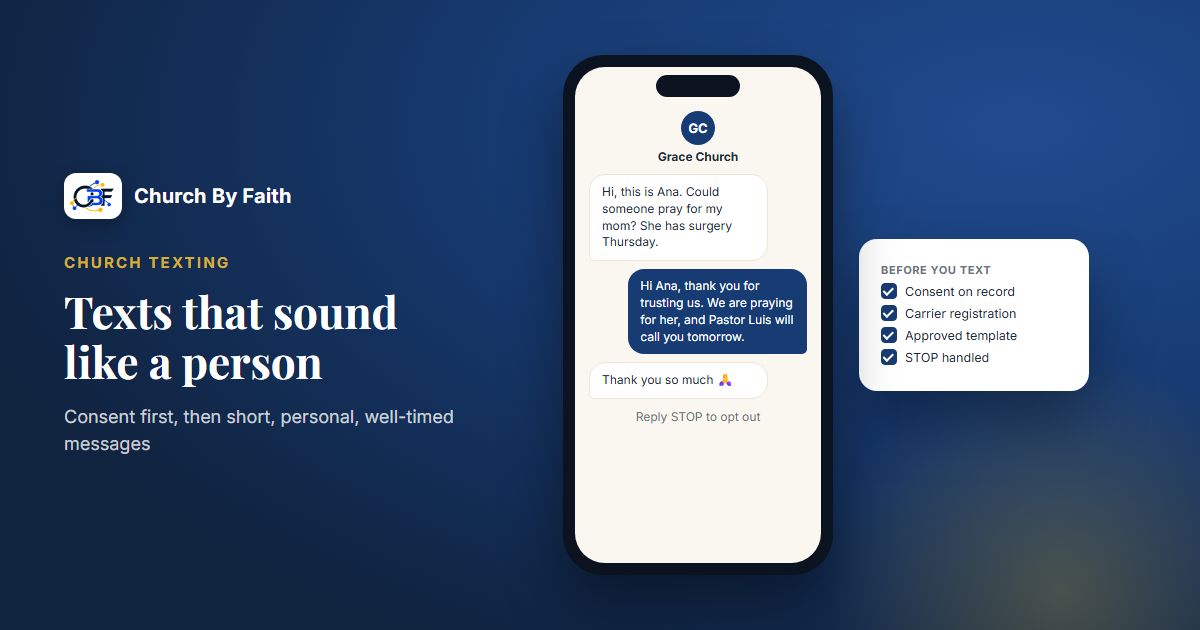
A text message lands in someone's pocket, beside messages from family and friends. That closeness is what makes texting so useful for a church, and it is also why a careless text feels intrusive. This guide covers what churches can reasonably text, what they shouldn't, and example wording you can adapt for visitors and members.
Before the first text: consent, registration and opt-out
Three things come before any wording.
Consent. Only text people who have clearly agreed to receive texts from your church. A phone number on a visitor form is not, by itself, agreement to be texted. Add a plain checkbox or sentence such as "Yes, the church may text me at this number," and keep a record of when and where each person agreed. If someone texts your church first, a reply to that conversation is natural, but ask before adding them to anything ongoing.
Registration. In the US, carriers expect organizations that text, including churches, to register their number and describe how they use it. This is often called A2P 10DLC registration. Unregistered texts may be filtered or blocked. Plan for the registration to take some time, and complete it before you announce texting.
Opt-out. Anyone must be able to stop your texts, and replying STOP is the standard way. When someone opts out, honor it right away and on every number and tool you use. Don't argue, and don't sneak in one last message.
Consent and texting laws vary, and they change. If you plan anything beyond personal replies, ask someone qualified to review your approach. This guide is practical advice, not legal advice.
Writing texts that sound like a person
Good church texts share a few habits.
- Say who you are. Start the first message with your name and the church: "Hi Maria, this is Pastor Luis from [Church Name]."
- Keep it short. One idea per text. If it needs paragraphs, it probably belongs in an email or a call.
- Ask one clear question. "Would Thursday or Saturday work better?" is easier to answer than an open invitation.
- Mind the clock. Text during reasonable daytime and early-evening hours in the recipient's time zone, unless they asked you to reach them at another time.
- Remember the lock screen. Texts often appear on screens other people can see. Never put sensitive details, such as a diagnosis, a family conflict or a confession, in a text.
- Write in their language. If a guest filled in the Spanish form, reply in Spanish.
- Sign with a real person. A text from "The Church" is easy to ignore. A text from Pastor Luis isn't.
Texts for visitors
Visitors are the group most likely to feel that a text is too much, so let them lead. Text visitors who asked to be contacted or gave permission, and keep each message personal.
After someone asks to be contacted:
Hi Daniel, this is Ana from the welcome team at [Church Name]. Thank you for visiting Sunday! You mentioned you'd like someone to reach out. Is there a good time this week for a short call?
When a visitor mentioned a prayer need on their form:
Hi Rosa, it's Pastor Luis. I saw your prayer request on Sunday and I've been praying for your mother's surgery. Would you like me to call you, or would you rather I just keep praying?
Answering a practical question:
Hi James, it's Ana from [Church Name]. Yes, we have a nursery for children under 4 during both services. Just ask for me at the welcome table and I'll walk you over.
When there is no reply: leave it. One friendly, unanswered text is fine. A second or third begins to feel like pressure. If they come back, pick up the conversation warmly.
Texts for members
With members, texting is at its best in pastoral moments where a short, personal message says "we noticed."
A check-in after a hard week:
Hi Carmen, it's Pastor Luis. I've been thinking about you since the funeral. No need to reply. We're praying for your family and we're here whenever you want to talk.
Following up on a prayer request:
Hi Marcus, it's Ruth from the prayer team. How is your job search going? We're still praying.
Confirming a visit or meeting:
Hi Elena, it's Pastor Luis. I'll come by the hospital around 3 tomorrow. Room 412, right? Let me know if that changes.
A simple thank-you to a volunteer:
Hi Tom, it's Sarah from the hospitality team. Thank you for staying late to set up chairs on Saturday. It made a real difference.
Notice what these have in common. They come from one person to another person, they are short, and they don't ask for anything the member can't easily give.
What not to send by text
- Sensitive pastoral content. Details of counseling, illness, finances or family conflict belong in a call or a private meeting.
- Mass announcements from a personal-style number. Sending the same text to everyone makes all your personal texts feel like broadcasts, and it usually needs a different kind of registration.
- Giving appeals out of nowhere. A text asking for money, with no prior relationship, feels like a scam, even when it isn't.
- Long threads that should be a conversation. If a text exchange is getting emotional or complicated, suggest a call.
- Anything to someone who opted out. No exceptions.
Many churches also want to send group reminders by text, such as "Youth group tonight at 7." That is bulk texting, which has its own consent and registration requirements. If you choose to do it, use a tool built and registered for that purpose, keep its opt-out list in step with everything else you use, and use it sparingly.
How Church By Faith handles texting
Church By Faith treats texting as a pastoral conversation, not a broadcast.
- One-to-one replies from the inbox. Staff reply by text to prayer requests, care conversations and other messages from the shared inbox, so the conversation stays with the church and the team can see it.
- The church's own number. Each church connects its own texting account in Communications settings and uses its own number. The church needs its own carrier (A2P 10DLC) registration, and By Faith Apps confirms it before the number is approved, so plan time for that step.
- Consent checks and STOP handling. A text reply requires the person's recorded consent for texting, and STOP requests are honored. Members can manage their own contact preferences in their profile.
- No bulk texting. There are no SMS campaigns, and automations don't include text steps. For news that goes to everyone, use email campaigns (on the Growth plan and up, at the time of writing) and the notice board. If you truly need group text reminders, a separate tool registered for that use is the honest answer.
You can see the rest of the communication tools on the features page, or contact us to talk through carrier registration before you start.
Quick checklist
- Add a clear, separate texting consent line to your forms.
- Complete carrier registration before you announce texting.
- Honor STOP immediately, everywhere.
- Start every first text with your name and the church's name.
- Keep texts short, personal and free of sensitive details.
- Reply in the person's language.
- Move emotional or complicated conversations to a call.
See how one-to-one texting from a shared church inbox works on the Church By Faith features page.