Discipleship & Groups
How to Welcome New Members Into Groups and Classes
By Church By Faith Team · · 5 min read
Joining a church is a start, not a finish. Here is how to help new members take their first step into a small group or class, and stay there.
When someone becomes a member, it is tempting to feel the work is done. In reality, the weeks after joining are when people decide whether this church will become home. The surest way to help them is to get them into a group or class where someone knows their name.
Why the first group matters
Sunday worship is where people meet the church. A group or class is where they meet people. It is where someone notices when they are absent, prays for them by name, and invites them to serve.
A new member who is not connected within the first couple of months can easily drift back to the edges. That is not a failure on their part; it usually means nobody made the next step clear or easy. Your job is to remove the guesswork.
Offer a clear, low-pressure first step
New members often do not know what groups exist, which one fits them, or whether they will be welcome mid-season. Make the first step obvious.
Choose one "front door" group or class. Many churches run a short newcomers class, a few weeks long, that covers the church's story, beliefs and ministries. It gives new members a natural place to meet each other and a leader who can then point them toward an ongoing group.
Keep a short menu of ongoing options. Instead of listing every group, recommend two or three that suit most people, for example:
- A weekday evening Bible study for adults
- A Spanish-language group for families
- A group for young adults or a men's or women's group
Make joining possible at any time. If a group only accepts people in September, say so, and offer something in the meantime.
Remove the practical barriers
Many people do not join a group for reasons that have nothing to do with faith. Ask about the obstacles and solve the ones you can:
- Childcare. Young parents may only be able to come if children are welcome or cared for.
- Language. In a bilingual church, make it clear which groups meet in English, which in Spanish, and which mix both.
- Schedule. Shift workers and parents may need a weekend morning or a lunchtime option.
- Transport. An older member may simply need a ride. A leader can often arrange one with a single phone call.
- Nerves. Some people worry they do not know the Bible well enough. Say plainly that questions are welcome and nobody will be tested.
A group that removes one real barrier often gains a faithful member for years.
Make a personal invitation
Announcements get attention; personal invitations get responses. Wherever you can, pair a written welcome with a real person.
Sample invitation wording
Hi Maria, we are so glad you have joined our church family. Our Thursday evening group is a warm, relaxed group that meets at the Lopez home, and I would love for you to try it. Would this week or next week work better for you? I can save you a seat.
Notice the pattern: a warm welcome, one specific group, a clear time, and a simple question that is easy to answer.
Who should invite
The best inviter is usually the group leader, not the church office. If the pastor makes the introduction, follow it with a message from the leader within a few days, so the new member has a face to look for.
Prepare your leaders to receive new people
A new member's first visit to a group shapes whether they come back. Give leaders a short welcome routine:
- Greet them by name and introduce them to one or two people before the meeting starts.
- Explain what happens in a typical meeting, so they are not guessing.
- Do not put them on the spot. No reading aloud or praying out loud unless they volunteer.
- Share practical details: where to park, whether there is childcare, what to bring.
- Follow up the next day with a short, personal message.
It also helps to agree on who owns each new member. When the leader accepts a new person, that leader is responsible for checking in over the next month.
Track the path in the first weeks
You do not need a complex system, but you do need to know who has connected and who has not. A simple routine works:
- Week 1: new member welcomed and invited to a specific group or class.
- Week 2–3: attended at least once? Leader sends a follow-up message.
- Week 4–6: still attending? If not, a pastor or leader reaches out personally, with no pressure.
- Month 3: check in: is this the right group, or would another fit better?
If someone tries a group and it does not fit, treat that as useful information rather than a failure. Offer a different group, a class, or a serving team instead. Some people connect best by doing something alongside others, such as helping in the kitchen or joining a prayer team, before they are ready to sit in a circle and talk.
Recording attendance at group meetings makes this easy to see. Review the list of recent members once a month and ask of each one: are they known by someone yet?
How Church By Faith handles this
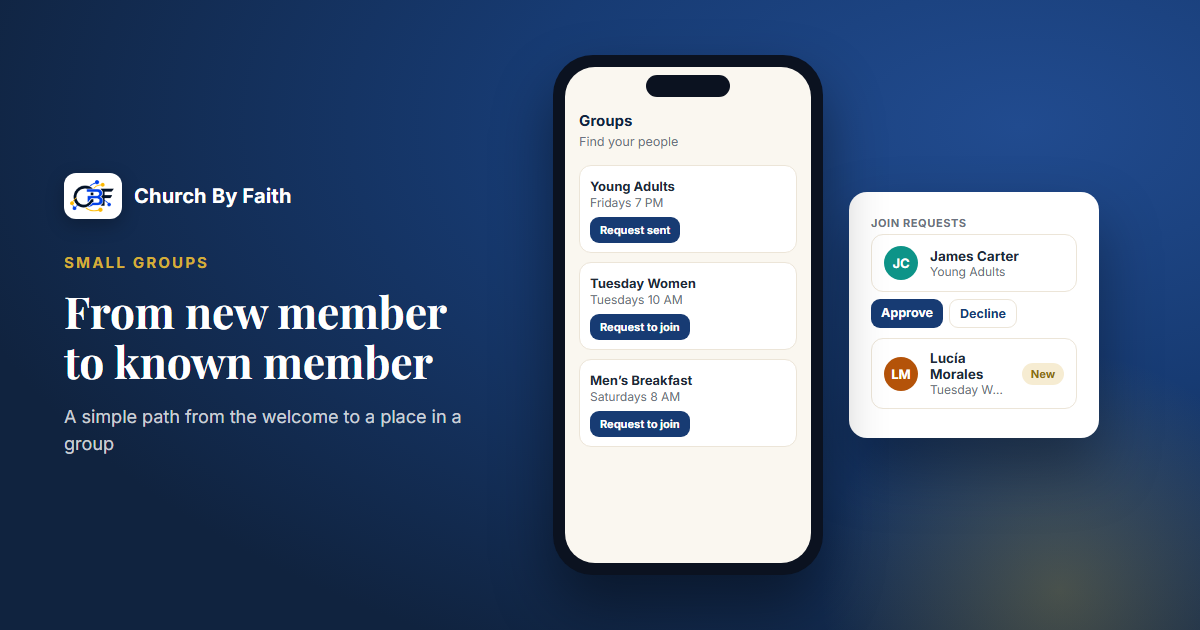
Church By Faith gives each group its own space, with a group picture, leaders, invitations and in-group messaging. New members can request to join a group, and the leader approves them from an approval queue, so groups stay safe and leaders know who is coming. Leaders and admins can moderate group conversations.
A few other tools support the path described above:
- Member welcome email. Automations can run when a member joins, with a "Member welcome" starter sequence you can adjust to point people toward groups. It starts as a draft, so your church decides when to turn it on.
- Attendance registers. Leaders can record present, absent or excused for each meeting, so you can see who has been showing up.
- Courses. A newcomers class can be run as a course with lessons, video lessons and quizzes, and each person's progress is tracked. Check which plan includes courses on the pricing page.
- Small group on the profile. Each profile can record the person's small group, alongside their visitor or member relationship.
There is no automatic group-matching or assimilation pathway in Church By Faith; the invitation and the follow-up are still made by people, which is how it should be. If you want help setting up your groups, contact us.
Quick checklist
- [ ] Choose one front-door group or newcomers class.
- [ ] Recommend two or three ongoing groups instead of a long list.
- [ ] Have the group leader send a personal invitation within a week.
- [ ] Give leaders a five-step welcome routine for first visits.
- [ ] Record attendance at group meetings.
- [ ] Review recent members monthly: is each one known by someone?
- [ ] Check in at three months about fit.
The early church "devoted themselves to the apostles' teaching and to fellowship" (Acts 2:42). A clear path into a group is simply how you make room for that today.
See how Church By Faith handles groups, join requests and leaders on the features page.